
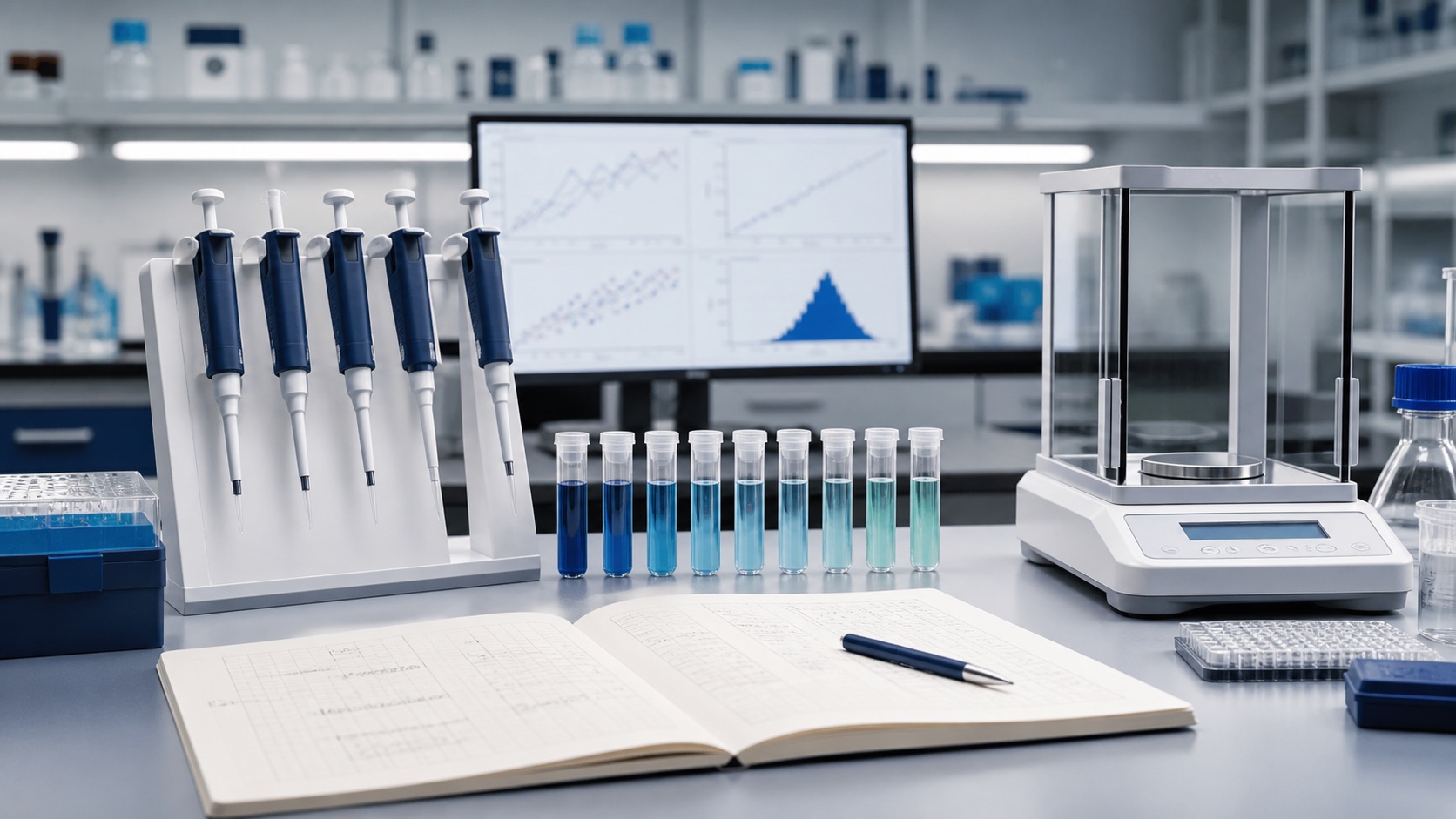
Overview
Laboratory measurements demand both accuracy and precision. Whether measuring sub-milligram quantities on an analytical balance or dispensing microliter volumes, the methodology used directly affects the validity of the experimental data.
Understanding the limitations of your equipment is as important as the technique itself. Environmental factors, such as air currents or pipette calibration, can introduce errors that propagate through every downstream step of an experiment.
Key Concepts
Analytical Weighing
Analytical balances are sensitive to air currents, vibrations, and temperature. Use a draft shield, ensure the balance is level, and weigh in a stable, temperate environment. Always use clean spatulas and weigh boats to avoid contamination.
Volumetric Dispensing
Correct pipetting technique is essential. This includes pre-wetting the pipette tip, aspirating at the correct angle, and ensuring consistent speed during aspiration and discharge to minimize volume errors.
Environmental Factors
Temperature affects liquid density, and humidity can affect the mass of hygroscopic compounds. Being aware of the laboratory environment is critical when making highly sensitive measurements.
Calibration Checks
Verify that your measuring instruments are within their calibration window. For critical experiments, perform a quick check using a standard weight or a water density check for pipettes.
Practical Application
Standardize your measurement workflow by developing a checklist for every procedure. For example, ensure the balance is tared and stable before adding the compound, and record the mass only after the reading has stabilized.
If a measurement error is suspected, stop immediately. Attempting to compensate for an inaccurate measurement later in the process only compounds the error and wastes valuable reagents.
Sources
- NIST Laboratory Weights and Balances Guidelines
- Fundamentals of Analytical Chemistry (Skoog et al.)
- ASTM E542 - Standard Practice for Calibration of Laboratory Volumetric Apparatus
Disclaimer: This content is for laboratory research use only. Not for human use or clinical applications.